
Industrial storage systems help warehouses, manufacturing plants, distribution centers, and other commercial facilities organize materials while maximizing available space. Depending on the operation, a storage system may need to accommodate full pallets, cartons, long materials, tools, equipment, or small components.
The right system does more than provide a place for inventory. It can improve space utilization, shorten picking and replenishment times, support safer material handling, and make products easier to locate. Storage design also affects how efficiently employees, forklifts, pallet jacks, and other equipment move throughout a facility.
Because every operation has different inventory, workflow, and space requirements, there is no single storage system that fits every application. Businesses may need pallet racks, shelving, high-density storage, automated systems, mezzanines, or a combination of several solutions.
HDCI Storage helps businesses evaluate their facilities and develop turnkey industrial storage solutions. From consultation to professional installation, we will optimize the storage system in your facility.
Types of Storage Solutions Overview
Industrial storage solutions can generally be classified by two factors: the type of load being stored and the level of automation used to retrieve it.
Major storage categories include:
- Pallet racking for large unit loads
- Shelving for cartons and manually handled products
- Bins and drawers for small parts and tools
- Cantilever racks for long materials
- Mezzanines and multi-tier storage for vertical expansion
- High-density systems for maximizing storage capacity
- Automated systems for machine-assisted storage and retrieval
Storage can also range from fully manual to highly automated. Employees may retrieve products directly from shelving, forklifts may serve pallet racks, or automated equipment may deliver items directly to a picking station.
The best choice depends on inventory volume, SKU count, turnover, available space, handling equipment, labor requirements, and budget.
Pallet Racking Systems
Pallet racking systems allow palletized inventory to be stored vertically rather than taking up large areas of warehouse floor space.
A typical pallet rack includes upright frames, horizontal beams, and supporting components arranged to hold pallets at multiple elevations. Forklifts, reach trucks, or other material handling equipment place and retrieve the loads.
Pallet racking works well for warehouses, distribution centers, manufacturing operations, and other facilities handling substantial quantities of palletized products.
Rack construction commonly falls into two categories: roll-form and structural steel.
Roll-form rack typically uses formed steel components and boltless beam connections. It is flexible and relatively easy to adjust when storage requirements change.
Structural rack uses heavier steel sections and bolted connections. It may be preferred for demanding environments, heavier loads, or operations where racks face more frequent equipment impact.
The appropriate construction depends on load weight, rack height, operating conditions, and engineering requirements.
Common Pallet Racking Types
Different pallet rack configurations provide different balances between accessibility and storage density.
Selective pallet racking provides direct access to nearly every pallet position. Because aisles separate each rack row, forklift operators can retrieve individual loads without moving other pallets first. This makes selective rack useful for facilities with many SKUs or frequent inventory turnover.
Drive-in pallet racking increases density by allowing forklifts to enter rack lanes and store pallets several positions deep. Fewer aisles are required, but individual pallet accessibility is reduced.
Push-back pallet racking also stores pallets multiple positions deep. Loads sit on carts or similar mechanisms and are loaded from one aisle. As a new pallet is added, the previous pallets move farther into the rack.
Double-deep pallet racking places one pallet position behind another. This reduces aisle requirements while maintaining relatively straightforward pallet access, although specialized lift equipment may be required.
Cantilever racking is designed for long or irregular materials. Horizontal arms extend from vertical columns without front uprights blocking access, making the system useful for products that cannot be stored effectively on standard pallet rack beams.
High-Density Storage
High-density storage systems increase the amount of inventory that fits within a facility by reducing aisles or storing loads multiple positions deep.
These systems are particularly useful when warehouse space is limited or expensive. Increasing density may allow a business to accommodate additional inventory without expanding or relocating.
The tradeoff is typically reduced selectivity. Conventional selective rack provides easy access to most pallets but requires more aisle space. Drive-in, push-back, shuttle, and mobile systems can store more inventory within the same footprint but may limit direct access to individual loads.
Facilities with larger quantities of fewer SKUs often benefit most from high-density storage.
Live Storage Options
Live storage uses gravity to move cartons or pallets toward a picking or unloading point.
Carton flow racks use inclined roller tracks that allow cartons or totes to move toward the picking face. Replenishment usually occurs from the opposite side, helping keep picking and restocking activities separated.
Pallet flow racks use the same basic concept for palletized inventory. Pallets travel along inclined lanes toward the unloading position as loads ahead of them are removed.
These systems can improve density while supporting faster product movement and inventory rotation.
Pallet Shuttle and Mobile Racking
A pallet shuttle system uses a motorized shuttle that travels within a storage lane beneath the pallets.
A forklift positions the shuttle and delivers pallets to the entrance of the lane. The shuttle then moves each pallet into the rack. Because forklifts do not need to drive deep into the system, shuttle racks can accommodate dense storage while reducing equipment movement inside the rack structure.
Mobile racking places rack rows on motorized bases that move along floor-mounted rails. Instead of maintaining an aisle between every row, the system opens an aisle only where access is needed.
This approach can significantly increase capacity when direct access to every rack row at the same time is unnecessary.
Automated Storage and Retrieval
An automated storage and retrieval system, or AS/RS, combines storage equipment with automated machinery and controls that place and retrieve inventory.
AS/RS equipment can handle both palletized and smaller loads.
Pallet-based systems may use automated cranes or shuttles to move unit loads into tall rack structures. Smaller systems can store cartons, totes, cases, or individual parts.
Automation is often considered when facilities need higher throughput, improved inventory control, reduced forklift travel, or more efficient use of vertical space.
Because automated systems generally require a larger initial investment, businesses should compare the cost with potential savings in labor, space, productivity, and inventory handling.
Narrow Aisle and VNA Automation
Reducing aisle width is another way to increase warehouse capacity.
Very narrow aisle systems, commonly called VNA systems, place rack rows closer together than conventional forklift layouts. This allows facilities to add storage positions without significantly increasing their footprint.
Because standard forklifts may not operate effectively in such tight aisles, warehouses typically use guided forklifts, reach equipment, or turret trucks.
Turret trucks can rotate their forks toward either side of an aisle without turning the entire vehicle. This allows them to work efficiently within narrow spaces while maintaining access to individual pallet positions.
VNA storage can provide a strong balance between density and selectivity without requiring full warehouse automation.
Automated Storage for Light Loads
Automated storage is also available for cartons, tools, parts, and other smaller items.
Horizontal and vertical carousels rotate storage carriers and deliver the requested inventory to the operator.
A vertical lift module, or VLM, stores trays inside a tall, enclosed structure. An automated extractor retrieves the required tray and delivers it to an access opening.
Both systems support a goods-to-person picking strategy. Instead of employees walking through aisles to find products, the equipment brings inventory directly to a workstation.
This approach can reduce walking, improve ergonomics, increase picking speed, and make better use of building height.
Shelving Systems and Small Parts Storage
Not every product requires pallet racking or powered material handling equipment.
Industrial shelving systems provide practical storage for cartons, supplies, components, maintenance materials, and other products that employees can handle manually.
Shelving can be configured as freestanding rows, wall-mounted systems, picking areas, or multi-level installations.
Wide-span shelving provides larger shelf openings and greater capacities than traditional shelving. It can accommodate bulky items that are still light enough to be handled manually.
Boltless shelving uses interlocking components instead of numerous nuts and bolts. It is relatively easy to assemble and reconfigure, making it useful when shelf heights or layouts may need to change.
Bin, Drawer, and Small Parts Systems
Small components require storage that keeps individual items organized and easy to identify.
Bin systems divide shelving into designated locations for individual parts or supplies. Clearly labeled bins can make picking faster while helping workers recognize low inventory.
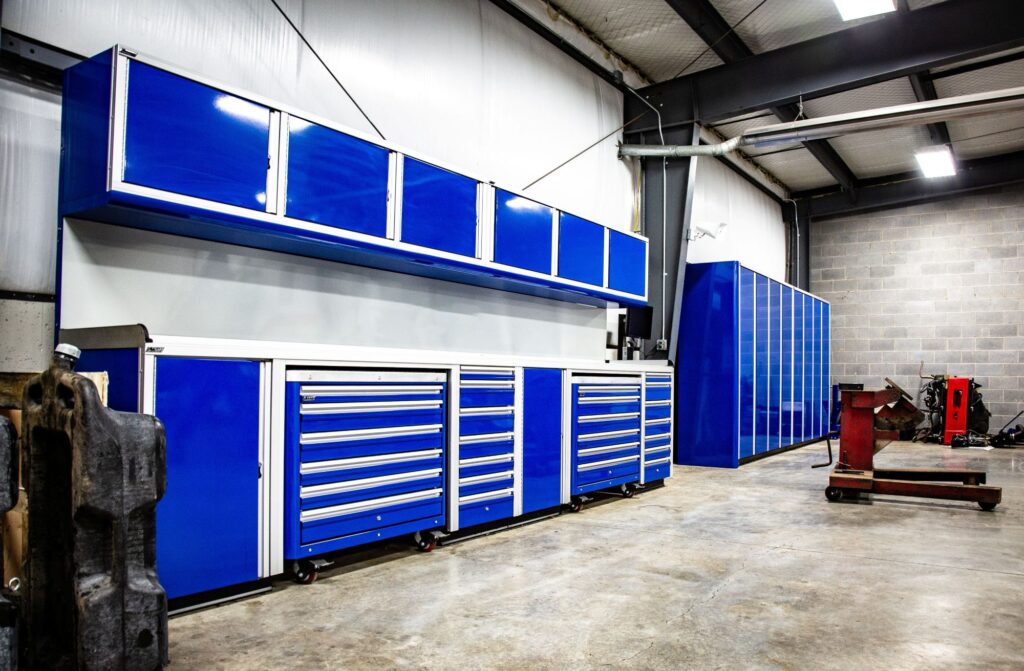
Drawer storage systems provide enclosed, compartmentalized storage for tools and components. Modular drawer cabinets can hold many individual items within a small footprint while helping maintain organization and accountability.
These systems are especially useful in maintenance departments, tool rooms, manufacturing environments, and parts storage areas.
Mezzanines and Multi-Tier Storage
When floor space is limited, facilities can often create additional usable space by taking advantage of building height.
An industrial mezzanine adds an elevated level inside an existing facility. The additional platform can be used for storage, shelving, picking areas, workstations, offices, or certain equipment applications.
Mezzanines can also support multi-tier storage systems that allow employees to access products at several elevations.
Before installing one, businesses should consider vertical clearance, structural loads, columns, stairs, guardrails, fire protection, egress, permitting, and applicable building codes.
Specialty and Environmental Storage
Some products require storage systems designed around unusual dimensions or environmental conditions.
Cantilever rack is particularly useful for long items because its open-front design allows materials to extend across several horizontal arms. It can accommodate products that would be difficult to store on conventional pallet racks.
Storage conditions also matter.
In cold storage and freezer environments, racking may need to withstand low temperatures, condensation, moisture, and specialized sanitation requirements.
Because refrigerated warehouse space is costly to build and operate, high-density storage can be especially valuable. Drive-in, pallet flow, shuttle, and mobile rack systems may help increase the number of pallets stored within refrigerated space.
Safety, Standards, and Compliance
Industrial storage systems must be designed and installed to safely support their intended loads.
Rack capacity, pallet dimensions, beam spacing, upright specifications, floor conditions, forklift clearances, and local seismic requirements can all affect how a system should be configured.
A qualified engineering review should be completed for each major installation rather than relying on a generic rack design.
Proper anchoring is also critical. Racking should be secured in accordance with the applicable design, manufacturer instructions, and local requirements. Facilities in seismic regions may require additional engineering and anchoring considerations.
Businesses should also consider rack protection in areas exposed to forklift traffic. Column protectors, barriers, guards, and adequate aisle clearances can help reduce damage caused by equipment impacts.
Regular inspection is equally important. Bent uprights, damaged beams, missing hardware, or visible impact damage should be evaluated promptly rather than ignored.
Turnkey and Custom Storage Solutions With HDCI
Selecting storage equipment is only one part of a successful warehouse project. The system must also fit the facility, inventory, material flow, and handling equipment.
HDCI provides turnkey storage solutions that can help businesses coordinate these different requirements through a single point of contact. From initial consultation through final installation, you'll work with one dedicated HDCI project manager — no handoffs between departments or vendors, backed by more than 40 years of storage and furniture experience through PSA Laboratory Furniture.
We offer free layout and CAD services to help customers evaluate configurations before purchasing equipment. We can also assist with planning, product selection, delivery, and professional installation.
A coordinated approach can be especially helpful for larger projects where multiple storage systems need to function together.
How to Choose the Right Storage Solution
Choosing the right storage system starts with understanding the operation.
First, assess SKU variety and turnover. Facilities with many frequently accessed SKUs usually need greater selectivity. Operations storing larger quantities of fewer products may benefit more from high-density configurations.
Next, measure available vertical storage space. Ceiling height can create opportunities for taller racks, mezzanines, VNA layouts, or automated vertical storage. Sprinklers, lighting, building structure, and required clearances must also be considered.
Evaluate your existing material handling equipment. A new rack configuration should work with current forklifts, reach trucks, pallet jacks, carts, or conveyors unless the project includes replacing that equipment.
Finally, establish your budget and ROI expectations. The least expensive system is not always the most economical in the long term. Consider how each option could affect capacity, labor requirements, picking time, equipment costs, inventory accuracy, and the need for future building expansion.
Request a Free Estimate From HDCI Today
The best industrial storage system should be designed around the way your facility operates rather than selected from a product catalog alone.
An onsite survey and customized CAD layout can help identify unused space, determine realistic storage capacity, and compare potential layouts before equipment is purchased.
If your warehouse, manufacturing plant, distribution center, or storage facility needs a new system, contact HDCI. Our team can evaluate your space, develop a layout, recommend appropriate equipment, and coordinate nationwide delivery and professional installation. Request a free estimate today, and a project manager will follow up within one business day.